Thomas Bourke
Optoelectronics | Semiconductor Physics | Nanoscience

Outside the Maxwell Centre in West Cambridge. Photo credit: Timothy Lambden.
Welcome to my academic website! I’m Thomas, a PhD candidate researching semiconductor single photon detectors for quantum networks.
I work interdisciplinarily across the Semiconductor Physics group at Cambridge University and the Quantum Information group at Toshiba, utilizing facilities at both institutions, including the state-of-the-art Cavendish cleanroom. I am supervised by Prof. Louise Hirst and Dr. Mark Stevenson, and am co-funded by Toshiba and the NanoDTC.
My current affiliations include:
- Toshiba Research Europe - Quantum Devices team
- Cambridge Nanoscience Doctoral Training Centre (NanoDTC)
- Darwin College - Cambridge’s first postgraduate college.
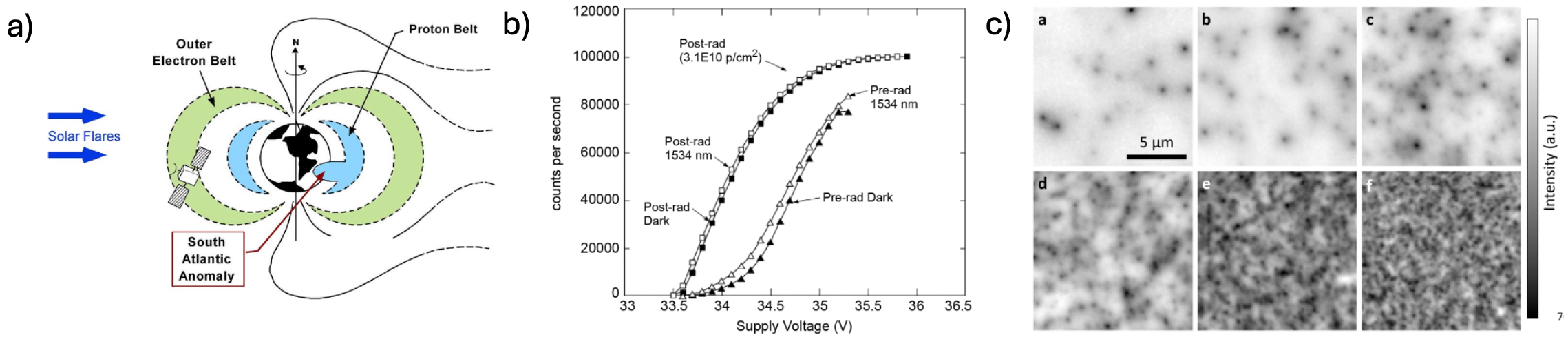
My work examines single-photon avalanche diodes (SPADs), which are small devices that count photons by converting weak optical pulses to electrical signals. I am currently investigating their performance in the space environment, where they face harsh radiation damage from solar wind. Looking forward, I hope to explore novel strategies for mitigating this damage. This will be useful for satellite quantum key distribution and deep-space optical communications.
Previously, I recieved a BSc and MPhys from the University of Bath (graduating in July 2025), including a research project in the Nanoscience group. I used molecular beam epitaxy (MBE) to grow monolayer NiI2 crystals and spin polarized scanning tunneling microscopy (STM) to examine their structure and magneto-electric dynamics.
Beyond physics research, I enjoy coffee, staying active, exploring new places and reading good books. You can find my reading list here!
References
[1] Johnston, Allan H. ‘Radiation Effects in Optoelectronic Devices’. IEEE Transactions on Nuclear Science 60, no. 3 (2013): 2054–73. doi.org/10.1109/TNS.2013.2259504.
[2] Barthel, A., L. Sayre, G. Kusch, R. A. Oliver, and L. C. Hirst. ‘Radiation Effects in Ultra-Thin GaAs Solar Cells’. Journal of Applied Physics 132, no. 18 (2022): 184501. doi.org/10.1063/5.0103381.
"The essence of the independent mind lies not in what it thinks, but in how it thinks."
